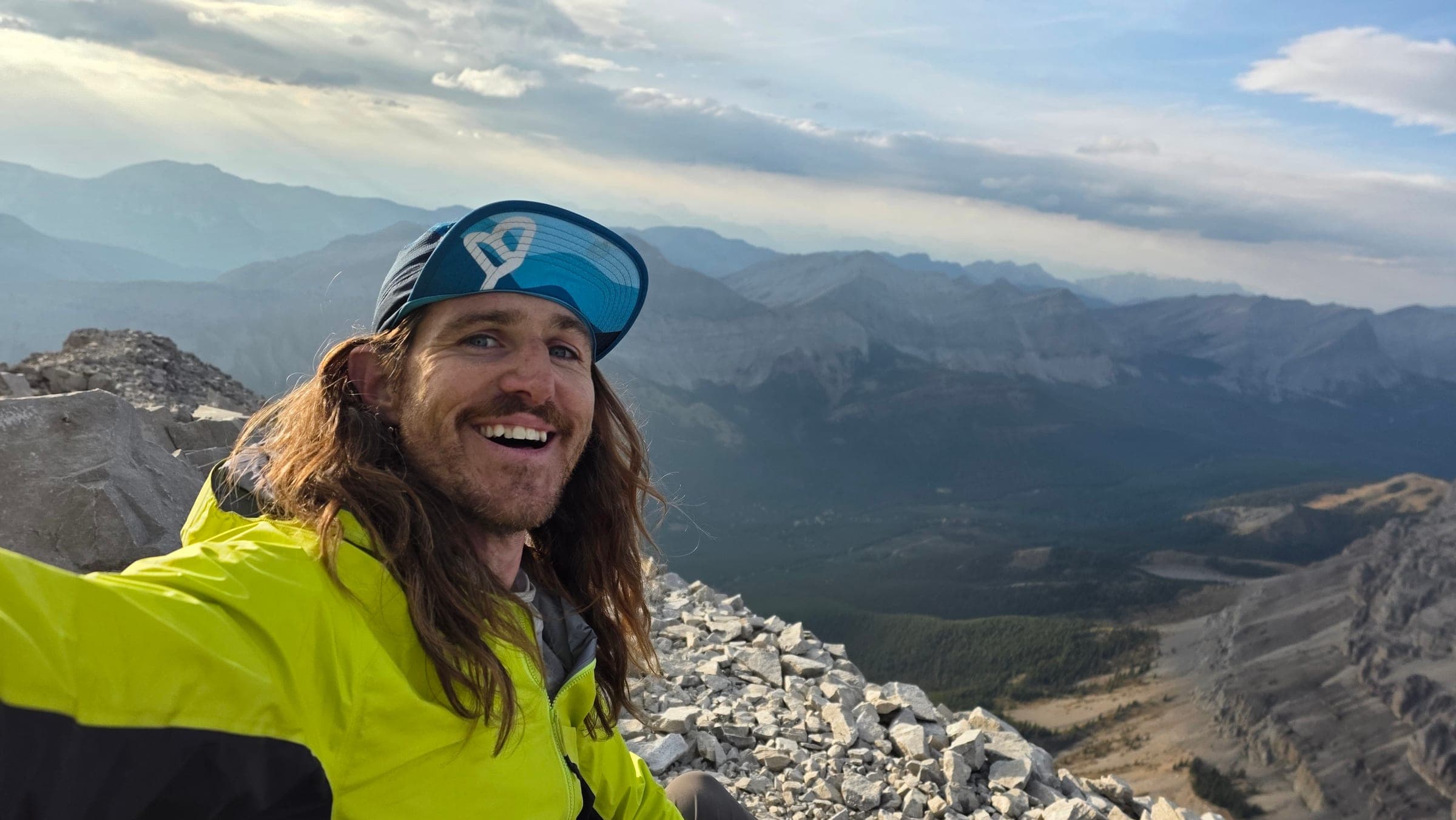
Coaching · Mentorship · Strategy
First 200s, multi-day
efforts, FKT attempts.
I coach the whole project.
Everybody has a plan until the second night. I do not write daily training programming. What you get is judgment on the route, the logistics, the fuelling, the crew, and the calls you will have to make when the plan starts moving under you. Twenty years across emergency medicine, fire, and industrial safety taught me how to read risk, plan for what actually goes wrong, and keep a team moving when it does.
How I Coach
Fewer athletes, more attention, better outcomes.
What I actually give you
I do not write daily programming. What I offer is judgment: route strategy, logistics, fuelling, crewing, pacing, and the mental work of big objectives. You already have the engine. My job is helping you point it at the right mountain and get it there intact.
Everything here I have done
It all comes out of projects I planned and executed myself: FKTs, six-day races, 200-milers on two continents, and nine days crewing a cross-Canada record. Route planning, logistics, nutrition, hydration, safety, energy management. That is the craft, and it is what you are hiring.
Small roster, real attention
High value and low frequency, on purpose. We book a call when there is something worth deciding, so you are never paying for phone time you did not need. Sessions are dense enough to change what you actually do, and the roster stays small enough that I know your name, your goal, and how your last block really went.
This coaching is for you if
- You have a specific objective: a first 200, a multi-day, an FKT attempt, or a season that scares you a little
- You want judgment and strategy from someone who has executed these projects himself
- You are self-motivated and will do the work between conversations
- You want your route, logistics, fueling, and crew plans pressure-tested before you commit
This is not the right fit if
- You want a daily training plan and weekly check-ins; there are excellent coaches who do that, and I will point you to them honestly
- You are looking for someone to make the hard calls for you out on the mountain; decisions out there are always yours
- You want a shortcut; the projects I coach reward patient, honest builds
Not sure which side you land on? Ask me directly and I will tell you straight.
The Proof Stack
Everything here came out of projects I ran myself.
This is the syllabus. Every one of them demanded the route planning, logistics, nutrition, hydration, safety, and energy management that I now coach.
Crowsnest High Five FKT
Standard Route FKT · Supported · 101.07 km · Five summits, one push · 21h 23m · 2026
Bob Marshall Traverse (NY) FKT
Unsupported out & back · 108.8 km, 9,377 m · With Cody Taylor · 40h 52m · 2026
Columbia Plateau Trail FKT
205 km · First person to complete it on foot · Polar vortex · 2021
Across the Years
701 km in six days · Around-the-clock course record · 2nd overall · 2019
Keji's Backyard Ultra
53 yards · 355 km · Backyard personal best · 2nd overall · 2024
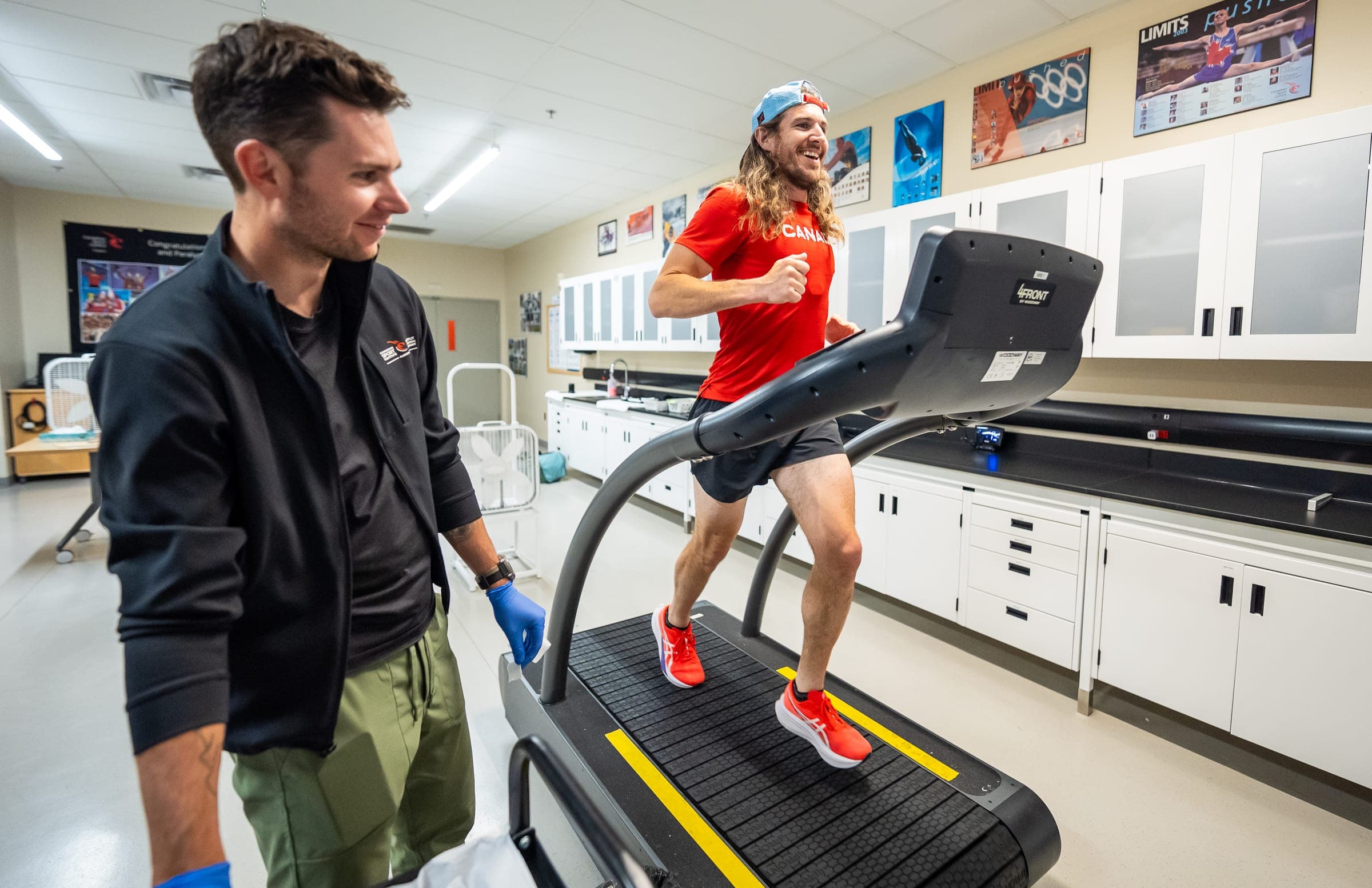
Up next: an unsupported FKT attempt on the 41 km Livingstone Range Traverse, where Adam Mertens set the mark at 10h 42m in June. It is the one goal I have left this summer, after taking the Crowsnest High Five Standard Route in 21h 23m on August 29.
Beyond the Running
Where the answers come from.
I have spent my working life being professionally responsible for what happens when something goes wrong, and that is where most of what I coach actually comes from. Twenty years of it, starting at eighteen.
Emergency medicine, and the team behind it
Medic training in the US Army, then structural fire and EMT-II work in Sitka, Alaska. Every call is real, and not one of them gets solved alone. You work the problem with the resources you brought, in whatever weather you got, on a network of trust where everyone knows their job and covers the person beside them. That is exactly what a crew does at kilometre 140, and it is the lesson I bring to any team.
Risk, and what it taught me
Years of health and safety work in Alberta's oil patch, and a Certificate in Health and Safety from the University of New Brunswick. The technical half is risk assessment, which is the discipline of working out what could go wrong, how likely it really is, and what it would cost you. That part transfers to a race plan almost unchanged. The half that shaped me was harder. Safety in that industry had a reputation for being a lecture nobody wanted, delivered to people who felt talked down to. I got further by using the rhythm I learned in the military: plan it, do it, then sit down afterward and talk honestly about what actually happened. When people get asked what they saw instead of told what to think, they start volunteering the near-misses, and that is where you get the lesson for free, before it costs anybody anything. I read an athlete's plan the same way, looking for what could go wrong and what it would cost you if it did.
Logistics, at race scale
As the former Manager of Field Operations for Sinister Sports I led the team that moved thousands of athletes through some of the hardest terrain in Canada. Course marking is the part I care most about, because flagging is really a conversation with somebody who is exhausted and no longer thinking clearly. You learn where a runner's eyes go at a junction, what stops registering at 2:00 AM, and how doubt behaves 12 hours into a race. Hang it properly and nobody leaves the course, and nobody notices you did anything at all. The rest of the work is heavier. Aid stations kitted out to feed hundreds of runners have to reach places that are hours away by ATV, and some days that means cutting a winter's worth of deadfall out of the trail to get there. Over the years that has also meant flat tires and a broken tie rod deep in the backcountry, building and then troubleshooting a radio repeater while a lightning storm moved through, and helping get injured and sick runners down off a mountain in the middle of a race. Every one of those happened with a clock running and only the resources we had carried in with us.
Two businesses, still running
MileAds Media Solutions puts highway-visible advertising within reach of businesses that could never afford an agency, and Klondike Gateway is a mobile home community my business partner Adrian and I took on to make it a genuinely better place to live. Both came from the same instinct: see something that could work better for the people in it, then spend a few years doing the unglamorous parts.
This collection of experience, and the particular set of skills it built, is where the real value sits. What you are buying is the pattern recognition of somebody who has stood in a lot of situations where the plan stopped working and something still had to happen next. That is a hard thing to build on your own, because the only way to get it is to be there, over and over, with something real on the line.
The Proof
Nine days as the only crew
on a cross-Canada record.
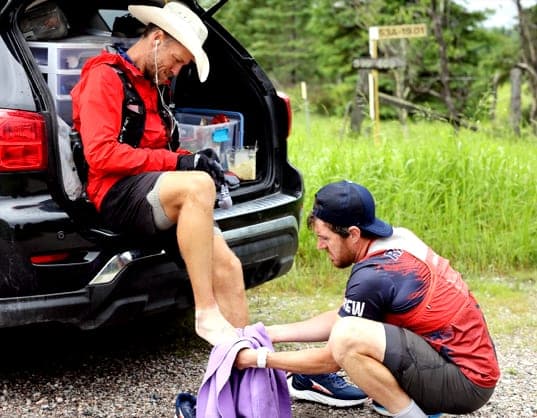
In 2022 Dave Proctor ran 7,159 kilometres across Canada in 67 days and 10 hours. I was his only crew for nine of those days.
Most of the work was planning the next day before it arrived. Where to fuel the vehicle, where to refill water, where to do laundry, where to buy food, and what the route had on it: bathrooms, bakeries, somewhere that could service the car. I charged his devices, made or bought his dinner and his breakfast, and loaded the recovery tools, clothes and equipment into the hotel every night and back into the car every morning.
During the day I drove 10 to 20 km ahead and set up his resupply so his stop stayed short. Then I ran 5 to 10 km back to meet him and came in with him. Dave had a good routine, which made that part simple. We did it again and again, 105 km a day. Running those legs put 70 to 80 km a day on my own feet, more than 650 km across the nine days.
It nearly ended on my first day. Dave went down and opened up his head, more than 40 days into the record. The wound wanted stitches, and out in remote Ontario that meant finding a hospital and burning hours he did not have. Stitches would have finished the run.
I was a few steps behind him when he fell, which was only possible because I was fit enough to be running it with him. I cleaned him up on the side of the road, and then I stayed close for the rest of the day so we could watch it together and stop if it turned. He ran his 105 km. Nine days in I handed over to Mike Huber and Joel Campbell, and Dave carried it the rest of the way across the country.
That is the job. Being fit enough to be out there beside you, trained enough to know what I am looking at when something happens, and steady enough that your project survives the day it nearly ends. It is the same thing I am offering an athlete on a call, just without the tailgate.
Featured in the film
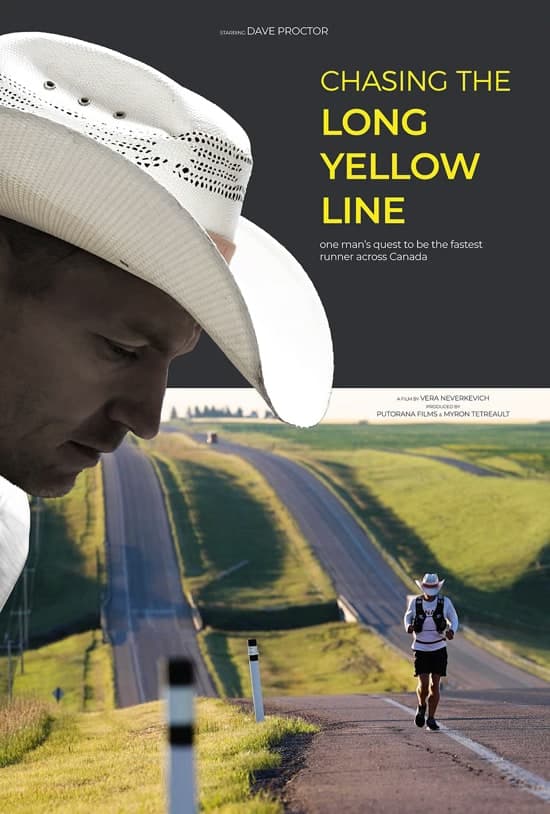
Chasing the Long Yellow Line
2025 · 1h 30m · Documentary · 1 award win
Vera Neverkevich Hill followed Dave for most of the 67 days it took him to run across Canada, averaging 105 km a day, chasing a record that had stood for 31 years. It is an Alberta film shot coast to coast, and it is honest about the cost of a project like that. The crewing in it, including my nine days, is the unglamorous machinery behind a record.
Written and directed by Vera Neverkevich Hill. IMDb rating from 19 ratings at the time of writing.
Free · Fifteen Minutes
Not sure any of this is for you? Let’s just talk.
Fifteen minutes, no charge and no pitch. Bring the project you are turning over, or the goal you have not said out loud yet. We can talk routes, mountains, weather, fuelling, the race that went badly, or the part of it that scares you. If it turns out I am not the right person for what you need, I will tell you that too, and point you at someone who is.
The Offerings
Six ways to work together.
All prices in Canadian dollars. Every offering starts with a conversation, and nothing here locks you into more than what is listed.
Flagship
Summit Session
90 minutes · One-on-one video call
$350
The flagship. Ninety minutes on your goal, your terrain, and your plan, with everything on the table: route strategy, logistics, nutrition, crewing, pacing, and the mental work.
- Intake questionnaire before we talk, so the call starts at full depth
- Written debrief with the decisions and action items after the call
- One week of email follow-up while you put the plan in motion
Summit Session Follow-up
45 minutes · Returning clients only
$150
A working check-in for athletes who have already done a Summit Session. We pick up where the debrief left off, adjust the plan, and keep the project moving.
- 45-minute call focused on what has changed since we last talked
- Updated notes appended to your original debrief
Big Project Advisory
Three calls across your build · Route and logistics review
$950
For the season-defining objective: a first 200, a multi-day, an FKT attempt. Three structured calls spaced across your build, plus a full review of your route plan and logistics before you commit.
- Kickoff call to frame the objective and map the build
- Mid-build call to adjust for how training is actually going
- Final call for race week: logistics, crew, contingencies
- Written route and logistics review between the second and final call
Crew Plan Review
Written review · 30-minute call
$275
You have a race and a crew. I pressure-test the plan. I have crewed a cross-Canada record and been crewed through six-day races, and the difference a real crew plan makes is enormous.
- Written review of your crew and logistics plan, checkpoint by checkpoint
- 30-minute call to walk through the findings with you or your crew chief
The Work Party
Virtual group intervals · Tuesdays and Thursdays · Capped around 24
$225
per 8-week block
An eight-week virtual interval block. Three groups run one shared intensity with the volume scaled per group, so a 50k runner and a 200-miler can hurt together at the same session. Show up twice a week and do the work.
- Two structured interval sessions per week for eight weeks
- Three volume groups at one shared intensity, scaled to your race distance
- A capped roster, around 24 athletes, so nobody disappears in the crowd
High Country Days
In-person small group · 2 to 3 runners · Established public trails
$450
per person · 2-person minimum
A full mountain training day with me in the high country, for two or three runners at a time, plus a 60-minute prep call before we go. A coaching experience on established public trails: we train movement, pacing, fueling, and decision-making on real terrain.
- 60-minute prep call to set objectives, route, and gear expectations
- A full mountain training day on established public trails, built around your objectives
- Debrief at the trailhead while the lessons are still fresh
How High Country Days works
High Country Days is a coaching experience: a small-group training run on established public trails. It is not a guiding service, and I am not a certified guide. You are responsible for your own fitness, your own equipment, and your own decisions in the mountains. Every participant completes a waiver and a self-sufficiency checklist before we meet at the trailhead. Routes stay on public land, outside parks and off private land, and the group stays small on purpose: two to three runners, two-person minimum.
How Booking Works
The first three steps of a much longer run.
1
Tell me what you are chasing
Pick the session that matches your objective and answer a few real questions about it. The form is brief, but the questions are not throwaway, and thinking them through carefully is the first useful work of the whole project. By the time we talk I already know your goal, your terrain, and where you suspect the weak points are, so we start at depth instead of spending the first half of the call catching up.
2
We pull the plan apart
I reply personally within 48 hours and we get a time on the books. On the call we go through the route, the pacing, the fuelling, and the crew, and we look for ways to improve the plan and prepare for the unexpected. If the project is bigger than one conversation can hold, Big Project Advisory carries it across your whole build with three calls and a full route and logistics review before you commit.
3
You leave with decisions
Decisions, written down, in a form you can hand straight to a crew chief. Then you go and do the work, and I stay reachable for the week after while you put it in motion.
Common Questions
Before you reach out
Coaching
Tell me what you are chasing
and where you are starting from.
I read every intake myself and reply within 48 hours. If I am not the right person for what you need, I will say so and point you at someone who is.