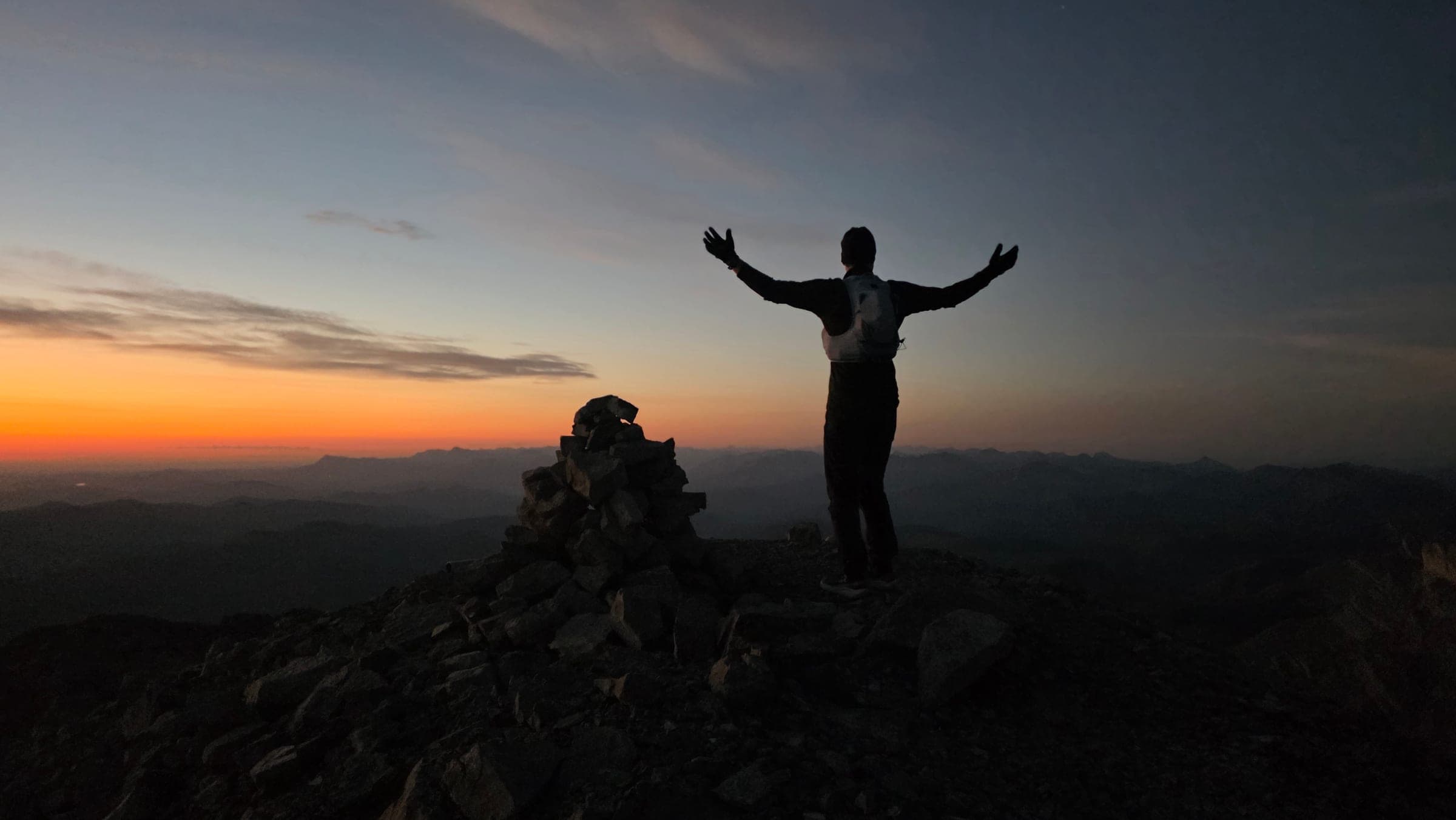
I want to start with a night in the mountains that I think about often, because it shows what this framework is made of better than any explanation I could give you. It is not where the framework came from. The Mountain Method came out of a lot of years and a lot of roles, and I will get to that. But this night is where the whole thing gets tested in one go.
In October 2020 I was about two weeks out from the Big Dog's Backyard Ultra national championship, and I wanted one more big day in the mountains before the race. I drove down to Calgary to meet a friend. She was an experienced runner with some big distances behind her, so I knew what she was capable of.
We planned the day out of the Little Elbow day use area in Kananaskis Country, Alberta. It sits at about 1,600 metres, and from there the old fireroad runs west and then south along the Little Elbow River, climbing gradually the whole way. We put two routes on the map. One was 50 kilometres, the other was 80, and they shared the same first section, so we did not have to decide right away. Partway in there was a junction where we could drop down to the shorter loop, and we agreed before we started that if we reached it in under three hours we would take the longer one. We got there inside of three hours feeling good, so we carried on with the 80.
That is the decision the rest of the day hangs on, and it is worth sitting with for a minute, because at the time it was not a hard call. We had a rule, we hit the rule, and we did what the rule said. The trouble is that a route like this narrows behind you as you go. The high point of the day is around 2,230 metres, up near Tombstone Pass, and once you are over the top and heading south you are into the Elbow-Sheep Wildland with the fireroad well behind you. From there our exits were the same length as finishing. The plan had one built-in escape and we spent it early, when everything was still going right. Every option after that involved covering the same amount of ground either way.
The trail deteriorated on us after that. What we thought would be runnable turned into a bushwhack, and our pace dropped hard. We were pushing through brush and picking our way over ground that took real attention, and the day started to stretch. By late afternoon we had been out considerably longer than the 8 to 10 hours we had planned for, and we still had a lot of country between us and the vehicle. The GPS from that day shows a low point down around 1,670 metres in the southeast corner of the loop, and from there the route turns north and climbs a pass at about 2,100 metres before it drops again. That climb came at us around the 55 kilometre mark, in the evening, with a bigger one still to come.
Somewhere in that stretch my friend started to come apart with it. She was getting sick, and she was tripping on her own feet and onto rocks, which tells you a lot about where somebody is at. The honest version of it is that she had packed for the day we planned and not for the day we ended up having. That is a mistake I have watched capable people make, and I have made versions of it myself. It only becomes serious when the day runs long, and this one ran very long. So I started giving her my food, because I could see she did not have enough of her own to keep going on.
By around 11:30 at night we were on the last climb of the day, and she was barely walking. I had given her the rest of my food and my jacket and my pants by then, because she had nothing warm for a night out and neither of us had planned on being out in the dark. We came up over the ridge and the wind hit us head-on, and standing there at the pace we were moving, in that cold, I knew we were not getting off that mountain together. We had no way to call anyone. I did not own a satellite communicator at the time, and there is no cell service in there.
So I made the call I did not want to make. I took her back down off the crest to the sheltered side, about a hundred and fifty metres below the top, out of the wind. I built her a small fire and sat her down and told her she was going to have to wait, and that I would be back in six hours. I gave her my headlamp and took her phone to use as my light, because I was carrying a battery that could keep her phone going and I was worried my headlamp would not survive the night.
Then I ran. Back up over the crest at about 2,010 metres and down the other side in the dark, and when I came to the river I went straight across instead of going around to the bridge, because that was faster. I got to the vehicle where my friend was waiting, drove thirty minutes up the road until I found service, and called for a helicopter. That is when I learned they could not fly into the mountains at night. So I told them I would go back up and be there before they arrived in the morning with food and warm clothes, and they agreed that was the safe call, because they trusted my fitness was there.
By that point I had a little over 80 kilometres on my legs. I drove back to the trailhead, loaded my pack with everything I could carry, and ran back up. I got there just after the first rescue worker arrived on a motorcycle. I sat with her about thirty minutes before the helicopter came in and long-lined us off the mountain, which means they lower somebody on a rope, harness you up, and lift all three of you off the side of the mountain hanging under the aircraft. The sun was coming up over the valley while we flew out. It was one of the most amazing experiences of my life, and I was trying not to look too happy about it, because a rescue is supposed to be a somber occasion.
We got home safe. I was lucky to have the fitness to move that far, that fast, on no notice.
When I got home I bought a Garmin inReach. It has been on me in the mountains ever since. That night is the most sobering experience I have had out there, because I had to leave a friend somewhere she could not take care of herself and just hope she would be alright while I went for help.
What I took from it
I turned that night over for a long time afterward. The question I kept coming back to was what actually made the difference out there, because if I could name it, I could build on it.
It was a set of skills built over years, a day I had actually planned for, and enough fitness to act on both. Toughness on its own would have had us both sitting on that ridge. And the thing that nearly cost us was a tool as well, a way to call for help, which I simply did not own yet.
That is the piece I want you to take from this. Your capacity to handle hard things is not fixed. It is trainable. It is built out of tools, preparation, judgment, and experience, and every one of those can be added to.
That night did not invent this idea for me so much as it proved it. I served as a combat medic in the U.S. Army from 2005 to 2009, and worked in fire and EMS in Alaska after that. I spent years in oilfield health and safety, where the job is making sure people go home to their families. In all of those roles you are making decisions with consequences attached, usually with incomplete information and not much time, and you get better at it the same way you get better at anything. The mountains are where I kept testing that, and coaching runners is where I watched it happen in other people. The Mountain Method is what came out of all of it.
Before I walk through the three pillars, it is worth explaining the biology underneath them, because that is what makes this a method rather than a pep talk.
The science underneath it
There is real science here, a biological principle called hormesis, which describes how the body and the nervous system rebuild stronger after the right dose of stress. We see it most obviously in physical training. You load a muscle, it breaks down, and it comes back with more capacity than it had before.
The Mountain Method is built on the idea that the same principle applies to the stress we meet at work, in leadership, and in daily life. The dose is the part that matters. I am not talking about reckless discomfort or suffering for its own sake. I am talking about deliberate, intentional stress that you choose to take on before you feel ready for it.
That gives us three pillars, and they run in order. The first one is about starting, the second is about staying in it when the terrain changes, and the third is about making sure the whole thing was worth something afterward.
Pillar one: Be bold, start cold
Start before you are ready. Not everything has to be perfect before you take the first step, and you can learn a great deal on the way.
This one comes straight out of running. Say it is minus five and you are heading out for a tempo run. If you start in a jacket, you will be too warm inside of ten minutes, and by the time you are into the workout you might be overheated. Now you have to stop, pull the jacket off and stuff it in your pack or tie it around your waist, and carry a jacket you did not need for the rest of the run. You only needed it for the first few minutes. So you start without it and trust your body to warm up as you get going.
The point is that starting is uncomfortable, and that is normal. Your body makes the adjustment in the first ten minutes.
Now, I am not suggesting anybody head out into minus thirty in a t-shirt, and the night I just described is exactly why I say that. There is a real difference between starting before conditions are perfect and starting without the things you need. We went into that day with a plan, two route options, and the skills to handle what we expected to find. What we did not have was a way to call for help when it went sideways. So the honest version of this pillar is that you do not need perfect conditions to begin, and you do need to know which of your gaps are survivable.
In an organization this is the team that has been circling a project for two quarters, waiting on the last piece of information before they commit. In most cases that last piece does not arrive until after the work is underway, and by then you have already learned things that changed the question.
Starting is the first half of the problem. The other half shows up once you are moving and the ground under you changes.
Pillar two: Respect the gradient
There is a learning curve to anything new. When you start, you will not have all the tools and the resources, because you are still learning what they are. You gather them as you go, and it gets easier as you get stronger at the task.
Here is how it looks on a mountain. On flat ground I might run a five minute kilometre. Add a hundred metres of elevation to that same kilometre, with loose footing and technical ground, and it is not a five minute kilometre anymore. I either work a great deal harder to hold that pace, or I hold my effort steady and let the pace be slower so I can pay attention to where I am putting my feet and not go off trail or go down.
Respecting the gradient means adjusting your pace and your plan to the terrain in front of you, while the goal stays where it is. If you take the easy path you can move fast. When you start going uphill, you adjust so you do not run out of energy before you get there.
This is the pillar that the Kananaskis day tests hardest, and it is why we put that three hour rule at the junction in the first place. We built a checkpoint into the plan so the terrain could tell us what to do, and that part worked. What we could not do, once the trail turned to bushwhacking and my friend started going downhill, was resize the day any further, because our one escape was a long way behind us. So the lesson I carry out of that day is to build your checkpoints early and to keep more of them available than you think you are going to need. A plan with one exit in it is a plan that stops adjusting the moment you pass it.
In a workplace, most people do not stall out because the goal is impossible. They stall out because they are looking at the entire project at once. They see the whole scope of it and think that is a lot of work and I do not even know where to start. In the keynote I ask people to find the smallest possible step they can take on the thing they want to accomplish, and then take that one.
So you started, and you adjusted, and you got through the hard thing. That leaves the question of what it was all for, which is where the third pillar comes in.
Pillar three: Cut the trail
This one has two meanings and I like it for that.
The first is repetition. As you walk a trail you leave footprints behind you, and if you walk it again and again and again, you start to build that trail into the ground.
The second is intention. If you go out there with your scissors and cut back some branches, take a chainsaw to the deadfall and clean it up, you have made that trail so much easier. It is easier because of the work you did to make it easy. You learned the skill and you refined it, and now the trail is clean.
Applied to a hard experience, that means not wasting the lesson. You take what the thing taught you and you build it into how you operate, so the next time through is different for you. That is exactly what the inReach is for me. It did not change what happened that night in Kananaskis, and I still carry it every single time I go out, because I am not going to be in that position again without a way to call for help.
Then it goes further than you. Other people can come and follow behind, because you led the way and there is a trail there for them now. You bring that to your organization and to the people around you and you can say, here is the system that I built, now you can use it, so you do not have to cut this trail yourself.
That is where leadership tends to show up in real life. It comes as a byproduct of somebody who learned something the hard way and then made it usable for everyone else.
I have found the ripple goes further than you can track, and it does not only run through systems and procedures. Recently a father asked me to take his son into the mountains, because the son was excited to get after some big objectives and the father was not able to go. I said sure, and I had the son pick the mountain and plan the route, so I knew he had done the research. We summited. The next week we did another one. Afterward the father asked what he owed me. I told him he did not owe me anything, and that if he really needed to give something back, he could find somebody else and do something for their benefit.
Who I built this for
Those three pillars are the whole framework, and the reason I put them into a keynote is that the pattern is not really about mountains.
I built this for teams and leaders who are carrying real weight and want a practical way to think about it. It is aimed at groups facing a change nobody chose, where the honest problem is that people are being asked to operate past what they have done before. Organizations that want their people to take on more, without burning through them to get there, are the room I have in mind.
It also fits schools and youth groups, where the message translates cleanly into starting before you feel ready and learning to tell the difference between something hard and something dangerous.
On the athletic side, I have run 701 kilometres at Across the Years, represented Team Canada five times at Big Dog's Backyard Ultra championships, and set the first recorded out-and-back fastest known time on the Bob Marshall Traverse in the Adirondacks with Cody Taylor, 108.80 kilometres in 40 hours, 52 minutes and 56 seconds. Last September I put down the first completion of the Crowsnest High Five, a five-summit route I put together with Jamie Lowe-Wylde, in 26 hours and 46 minutes. I am going back this year to take it under 24.
For all of that, the accomplishment I am proudest of is not one of mine. In 2022 my friend Dave Proctor ran across Canada in 67 days. I joined him for nine straight days of it as his crew, running 70 to 80 kilometres a day alongside him while driving the vehicle, planning routes around construction, doing the grocery runs, cooking, laundry, and packing and unpacking at every hotel. My job was to make sure nothing else required his attention. The most valuable thing you can do with your skills is put them in service of someone else's great effort. That belief sits underneath everything in this framework, and it is the reason the third pillar exists.
How to get started
If you are putting a program together and this fits what you are trying to do for your people, reach out through goshep.run and tell me about the room. Who is in it, what they are facing, and what you want them walking out with.
If you would rather start on your own before you start with me, take the pillars out for a run yourself. Pick the thing you have been circling. Find the smallest step in it, small enough that it is not really a question of whether you can do it. Take that step this week, before conditions are right. Then write down what it taught you, and change one thing about how you work because of it. That is pillar one, pillar two, and pillar three, at a scale you can finish before Friday.
The keynote gives your people the framework, the stories, and the room to work out where their own next step is.